


Plug the gaps in your teeth and smile with confidence
Dental implants look, feel, and function just like your natural teeth


Why choose dental implants?
Missing teeth can make you feel like hiding your smile. They can also affect your oral health, making it harder to eat and drink. If you’re looking for a permanent solution, implants at our Hillsborough practice could be for you.
Dental implants are a permanent, natural-looking way to replace missing teeth and restore your smile. An implant acts like a new tooth root, securing a crown or bridge in place and helping to preserve jawbone health. Whether you're missing one tooth or several, implants look, feel, and function just like natural teeth, giving you back the confidence to smile, eat, and speak comfortably.


Book a free virtual consultation
Your first consultation is completely free and there’s no obligation to go ahead with treatment.
Who will you see?
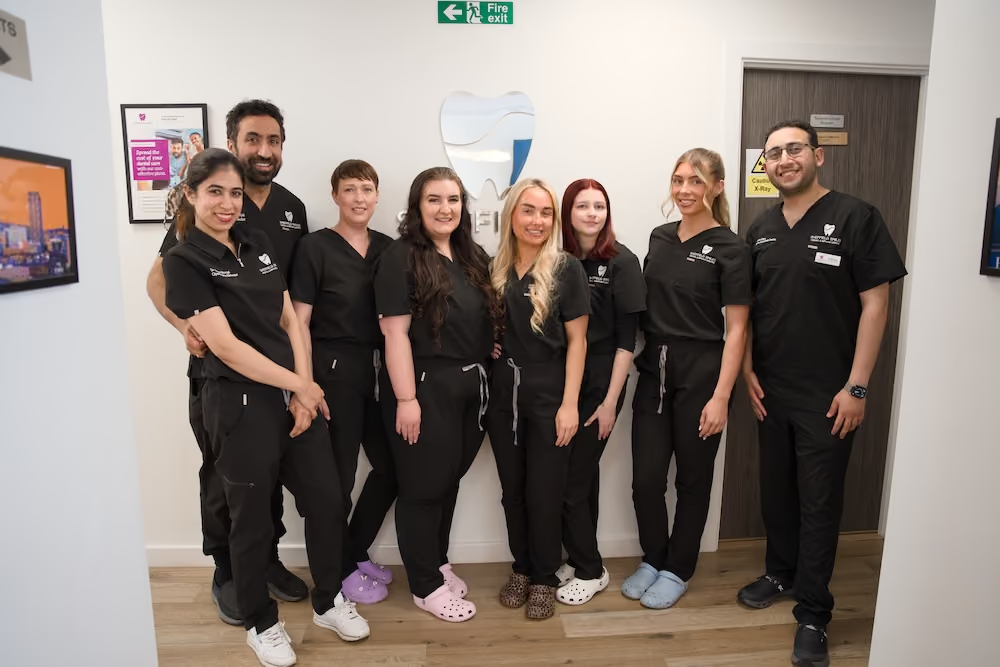
Our team is made up of highly-trained dentists and sedation professionals, making sure every part of your treatment is looked after. We’ll work together to give you our expertise.

Dr Nigel Hargreaves
Dr Nigel Hargreaves is a highly skilled dentist with a passion for restoring patients’ smiles and confidence. With years of experience in both implantology and restorative dentistry, Dr Nigel combines a meticulous approach with advanced techniques to provide seamless, long-lasting results.

Dr. Raggi is a passionate dentist who truly cares for his patients and my conversations with him have highlighted how much he believes in a 5* dental experience for his patients. I highly recommend you visit his practice if you are looking for a modern practice with staff who will look after you and your family. Whether you are considering whitening, invisalign, composite bonding or implants this is the place to go. If you are in Sheffield, look no further.


How do dental implants work?
Dental implants are a two-part solution for missing teeth. First, a titanium implant is placed into your jawbone to act as an artificial tooth root. Over time, the implant fuses with your bone, creating a stable foundation for a crown or bridge. Once you’re completely healed, your dentist will attach a custom-made crown that matches the colour, shape, and feel of your natural teeth. You can have either one implant or a whole set of them.
It usually takes 3-6 months for the entire treatment process, allowing time for the implant to fully integrate with your bone. Your dentist will guide you through the healing period, ensuring everything progresses smoothly. Implants are cared for just like natural teeth and can last a lifetime with proper hygiene. We use Straumann and Anthogyr, which offer the best possible options for colour-matching and durability.
Missing even one tooth can have a huge impact on your confidence and your daily life, but single dental implants can restore your smile. Blending seamlessly with your natural teeth, your new implant will help prevent bone loss and preserve your oral health, giving you a strong, comfortable replacement that feels like part of your natural smile.
Full arch rehabilitation with dental implants is a transformative treatment for anyone missing most or all of the teeth in the upper or lower jaw. Your dentist will strategically place implants throughout the gap, creating a secure foundation for a full set of artificial teeth.
Top dental technology makes implant treatment quicker and more accurate
Our highly skilled team, combined with the latest technology, is the perfect recipe for creating the best possible smile for you.
- Itero scanning and Dexis intraoral scanner allow you to visualise what a straighter smile would look like on you
- CBCT scanner for precision dental implant placement planning
- Personalised video treatment plans explain everything and you can watch them back as often as you like
- 3D scans mean no messy putty for impressions


Real people, restored smiles
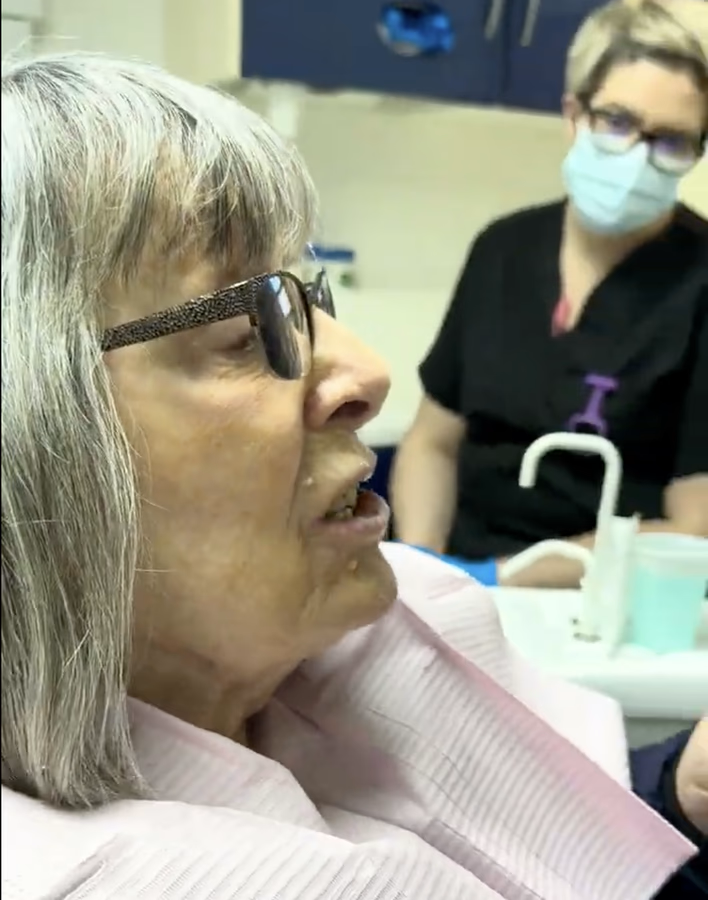
We’ve helped hundreds of people in Sheffield, as well as the surrounding areas of Hillsborough, Wadsley Bridge and Ecclesfield, to restore their missing teeth and their confidence along with it. See their results for yourself.
Rated 5 stars on Google – here's why...




Your journey to a fuller smile
Speak to one of the team on the phone

This free, initial chat will go over any initial questions you have and make sure the team has everything they need to advise you. You’ll also be asked to send in photos of your teeth.
Free virtual consultation

Meet with your dentist over video call to speak about your smile goals and go through treatment options, costs, and more. This is a no-obligation chat to give you an idea of the costs and timelines involved with getting your teeth how you’d like them.
In-depth consultation

Join your dentist for a full dental examination including scans, X-rays, and photos of your mouth. Your dentist will tell you more about their suggested treatment plan and can give you information about finance options.
If you’re a nervous patient, don’t worry — your dentist is super experienced in soothing anxieties and will go at your pace, explaining everything along the way.
Planning and placing your implant(s)

Your dentist will do any further scans needed to get your mouth ready, then it’s time to fit the roots of your implants. We always use local anaesthetic to numb the area but we can also arrange sedation for more complex treatments or if you’re feeling nervous.
Once the titanium roots are in, your dentist will fit a temporary restoration to fill the gap while the root heals.
Full restoration

Once your implant has healed, it’s time to restore your smile! Depending on your goals, this might mean installing a crown or a number of artificial teeth onto your implants. Whatever you go for will be matched to your teeth to create a natural, seamless look. At this point, your dentist will check everything and give you advice to help keep your implants looking fresh. Then, it’s time to enjoy your new smile.
Frequently asked questions
at Sheffield Smiles
Dental implants
Are dental implants right for me?
If you’re looking for a permanent solution to replace missing teeth, dental implants may be a great choice. They provide stability and look and function just like a natural tooth. During your free consultation, your dentist can assess your needs and determine if implants are the best option for you.
Who can have dental implants?
If you’re over 18 and are in good health, you should be able to have implants. However, your gums and jawbone need to be healthy enough to sustain them, so your dentist will need to examine your mouth to make sure implants are the right fit for you.
How long does it take to fit implants?
Typically, dental implants take around 3-6 months from start to finish, depending on the healing process and individual circumstances. Your dentist will give you a more accurate timeline during your consultation.
How long do dental implants last?
Well-cared-for implants are permanent and can last a lifetime. As with your natural teeth, regular dental check-ups and hygienist visits will help keep them healthy and looking good.
How do I care for dental implants?
Just as you would your natural teeth. You should brush twice a day, floss, and see your dentist regularly to keep them in the best shape.

0% interest on dental implants in Sheffield and Hillsborough
Our finance options are here to help you get the smile you deserve without worrying about costs:
- 0% interest for up to 12 months
- No deposit needed
- Minimum spend of £1000
- Sheffield Smiles Club plans start at £14.95 per month for adults and include discounts on cosmetic treatment
Ready to restore your smile?
Speak to one of our team for a no-obligation consultation to find out how we can help you get the most out of your smile.

Privacy Policy
Confidentiality policy for the practice team
The need for the strict confidentiality of personal information about patients is essential.
This document describes our policy for maintaining the confidentiality of all personal information and all members of the practice team are required to comply with these safeguards as part of their contract of employment or contract for services with the practice.
The importance of confidentiality
The relationship between orthodontist/dentist and patient is based on the understanding that any information revealed by the patient to the dentist will not be divulged without the patient’s consent.
Patients have the right to privacy and it is vital that they give the orthodontist full information on their state of health to ensure that treatment is carried out safely.
The intensely personal nature of health information means that most patients would be reluctant to provide this information if they believed that it would be passed on.
If confidentiality is breached, the orthodontists, dentist, dental hygienist, dental therapist or dental nurse concerned faces investigation by the General Dental Council (GDC) and possible erasure from the Dentists or DCP Register. They may also face legal action by the patient for damages and, for dentists, prosecution for breach of the Data Protection Act.
General Dental Council
All staff must follow the General Dental Council’s rules for maintaining patient confidentiality contained in its publication ‘Standards for the dental team’ (visit: gdc-uk.org). If confidentiality is breached, each registered dental professional involved is responsible to the GDC for their individual conduct.
What is personal information?
In a dental context, personal information held by a dentist about a patient includes:The patient’s name, current and previous addresses, bank account/credit card details, telephone number/email address and other means of personal identification such as physical description Information that the individual is or has been a patient of the practice or attended, cancelled or failed to attend an appointment on a certain day.
- Information concerning the patient’s physical, mental or oral health or condition
- Information about the treatment that is planned, is being or has been provided
- Information about family members and personal circumstances supplied by the patient to others
- The amount that was paid for treatment, the amount owing or the fact that the patient is a debtor to the practice.
Principles of confidentiality
Personal information about a patient Is confidential in respect of that patient and to those providing the patient with health care should only be disclosed to those who would be unable to provide effective care and treatment without that information (the need-to-know concept), and should not be disclosed to third parties without the consent of the patient except in certain specific circumstances described in this policy.
Disclosures to third parties
There are certain restricted circumstances in which a dentist may decide to disclose information to a third party or may be required to disclose by law. Responsibility for disclosure rests with the patient’s dentist and under no circumstances can any other member of staff make a decision to disclose.
Personal information can be disclosed where:
The patient has expressly given consent to the disclosure
- Disclosure is necessary for the purpose of enabling someone else to provide health care to the patient and the patient has consented to this sharing of information
- Disclosure is required by statute or is ordered by a court of law
- Disclosure is necessary for a dentist to pursue a bona-fide legal claim against a patient and disclosure to a solicitor, court or debt collecting agency may be necessary.
Public interest
There are certain circumstances where the wider public interest outweighs the rights of the patient to confidentiality. This might include cases where disclosure would prevent a serious future risk to the public or assist in the prevention or prosecution of serious crime.
NHS care Information may need to be disclosed to third party organisations to ensure the provision of care and the proper functioning of the NHS. In practical terms this type of disclosure means:
Transmission of claims/information to payment authorities such as the Business Services Authority for England and Wales.In more limited circumstances, disclosure of information to Health Board for Scotland and Wales
Referral of the patient to another dentist or health care provider such as a hospital.
Data protection code of practice
The Practice ‘data protection code of practice for patients’ provides the required procedures to ensure that we comply with the Data Protection Act 1998. It also describes to patients the personal data that we collect , how we use it and our procedures for storing it safely and securely. It is a condition of engagement that everyone at the practice complies with the code of practice.
Access to records
Patients have the right of access to their health records held on paper or on computer. A request from a patient to see records or for a copy must be referred to the patient’s dentist. The patient should be given the opportunity of coming into the practice to discuss the records and will then be given a photocopy or print-out.Care should be taken to ensure that the individual seeking access is the patient in question and where necessary the practice will seek information from the patient to confirm identity.The copy of the record must be supplied within forty days of payment of the fee and receipt of identifying information if this is requested.
Access may be obtained by making a request in writing and the payment of a fee for access of up to £10 (for records held on computer) or £50 (for those held manually, including non-digital radiographs).
A copy of the record and, if required, an explanation will be provided within 40 days of receipt of the request and fee (where payable).
The fact that patients have the right of access to their records makes it essential for information to be recorded properly.
Records must be:
- Contemporaneous and dated
- Accurate and comprehensive
- Neat, legible and written in ink
- Strictly necessary for the purpose
- Not derogatory
- Such that disclosure to the patient would be unproblematic.
- Signed by the dentist
Practical rules
The principles of confidentiality give rise to a number of practice rules that everyone in the practice must observe:
- Records must be kept secure and in a location where it is not possible for other patients or individuals to read them
- Patients should not be able to see information contained in appointment books, day sheets or computer screens
- Discussions about patients should not take place in public areas of the practice
- When talking to a patient on the telephone or in person in a public area care should be taken that sensitive information is not overheard by other patients
- Messages about a patient’s care should not be left with third parties or left on answering machines. A message to call the practice is all that can be left
- Recall cards and other personal information must be sent in an envelopeIdentifiable information about patients must not be discussed with anyone outside of the practice including relatives or friends
- Demonstrations of the practice’s administrative/computer systems should not involve actual patient information
- A school should not be given information about whether a child attended for an appointment on a particular day. It should be suggested that the child is asked to obtain the dentist’s signature on his or her appointment card to signify attendance
- Do not provide information about a patient’s appointment record to a patient’s employer, unless the patient’s consent is obtained, such queries must be referred to the dentist
- Disclosure of appointment books, record cards or other information should not be made to police officers or HM Revenue and Customs officials unless upon the instructions of the dentist.
Disciplinary action
If, after investigation, a member of staff is found to have breached patient confidentiality or this policy, he or she shall be liable to summary dismissal in accordance with the practice’s disciplinary policy.
Employees are reminded that all personal data processed at the practice must by law remain confidential after your employment has terminated.It is an offence under section 55(1) of the Data Protection Act 1998, knowingly or recklessly, without the consent of the data controller, to obtain or disclose personal data.
If the practice suspects that you have committed such an offence, it will contact the Office of the Information Commissioner and you may be prosecuted by the Commissioner or by the Director of Public prosecutions.
Queries
Queries about confidentiality should be addressed to the data controller c/o the practice.